Demonstrates five practical guitar chord tricks—adding thirds to power chords, droning bass notes, inversions, and voicing tweaks—to make progressions sound richer and more powerful.

Demonstrates five practical guitar chord tricks—adding thirds to power chords, droning bass notes, inversions, and voicing tweaks—to make progressions sound richer and more powerful.
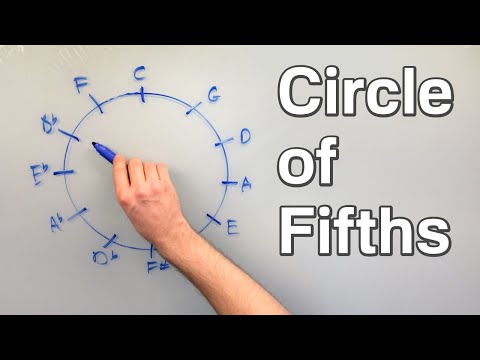
Explains and demonstrates the circle of fifths with quick memorization tips and practical uses for key signatures, chords, and modulation.
Teach mandolin arpeggios across all keys and show how to use chord tones to harmonize a melody, with exercises for speed and accuracy.

Explain the Nashville Number System and why thinking in numbers simplifies transposition, band communication, and ear training across keys.

Explain I–IV–V in any key on mandolin, movable chord shapes, pentatonic skip-a-fret lead patterns, blue notes, and simple double-stop positions for bluegrass leads.

Share fingerstyle technique insights, chord voicings, capo-based transposition, and setup preferences, demonstrating independent bass and inner lines characteristic of his style.

Demonstrates how to outline chord changes in solos by finding movable chord shapes within pentatonic patterns (CAGED approach) and practicing integrating chord tones over progressions.
Explains advanced mandolin practice focused on chord-tone improvisation, arpeggios, and making the changes across circle-of-fifths progressions, with examples from bluegrass and jazz.

Explain diatonic chords in major keys using Roman numerals, how to build progressions, transpose between keys, and improve ear-based recognition.

Demonstrates mandolin double-stop exercises to develop fingerings, intonation, and harmonic awareness across pairs of strings.
Present an Android app that generates scale-based melodies for practice, ear training, call-and-response, and harmony experimentation, with metronome, dual tempos, and looping.

Teach a one-minute method to build E/A-string scales, harmonize them with seventh-chord shapes, and craft math rock/post rock/emo progressions on guitar.

Shows beginners how to use two-string dyads and power-chord shapes to imply chords, covering basic intervals and simple accompaniment ideas.

Survey the 24 permutations of the I-V-vi-IV 'four chords' with examples from popular music to illustrate how progression order shapes sound.

Provide an interactive circle of fifths that lets you set tonic and mode to instantly display the seven diatonic chords for any key or mode.

Asks for guidance on deepening chord‑progression skills—why they work and how to “tell a story”—inviting theory, voice‑leading, and practice strategies.
Analyze why the Am–E–C–D–F–Am–B7–E progression works, touching on chromatic bass motion, modal mixture, and functional harmony.
Demonstrates practical phrases and strategies for improvising over jazz ii–V–I changes on guitar, including ear-training, chord-tone targeting, and position-based fretboard mapping.

Explain chord extensions and suspensions, contrasting classical voice-leading origins with modern independent chord use, and providing practical guidance for beginners.
Provide a curated list of 25 jazz standards with brief harmonic analyses and five essential recordings each to guide learning and listening.

Seek guidance on when to use sus4 and add9 chords on various scale degrees and how they function within a key.
Share a progressive path from intervals to drop-2 chord voicings and the circle of fifths, with exercises and learning strategies based on memory/comprehensible input.

Demonstrates essential jazz guitar chord types—minor, dominant, altered dominant, and major seventh—with quick voicings to get started.

Present a video defending the minor ninth interval beyond dominant chords, with timecoded classical, jazz, and pop examples illustrating its expressive harmonic use.

Presents five beginner-friendly jazz soloing exercises for nailing chord changes and flowing through progressions, with a video and prompt for additional practice ideas.

Ask for strategies to remember diatonic chords in each key, likely discussing Roman numerals, scale degrees, and circle-of-fifths approaches.
Teaches quick shapes to play common 7th chords on guitar in under a minute, offering concise voicings as alternatives to standard barre chords.

Teach an exercise to expand jazz chord voicings and begin chord-melody arranging on guitar.

Demonstrates how to use double-stops within CAGED chord shapes to highlight intervals and create harmonies across adjacent strings.

Show practical strategies for turning triads into lead guitar licks that nail chord changes and create melodic solos, with fretboard shapes and examples.

Presents a practical jazz guitar chord system for connecting chord types and turning symbols into musical, voice-led comping without memorizing endless shapes.

Explain how mapping I–IV–V triads within CAGED shapes unlocks melodic playing across the fretboard, with examples and a handy fretboard tool link.

Explain how the physics of sound underpins consonance and dissonance, showing how intervals, scales, and chords arise and why context changes perceived tension.

Demonstrates a straightforward method to convert familiar guitar shapes into colorful, playable jazz chord voicings for richer comping options.

Demonstrates how A major triad chord shapes connect to the A major scale across the fretboard to map harmony and melody.

Teach a simple one-string drill to target chord tones at changes so guitar solos resolve musically instead of sounding like random scale runs.